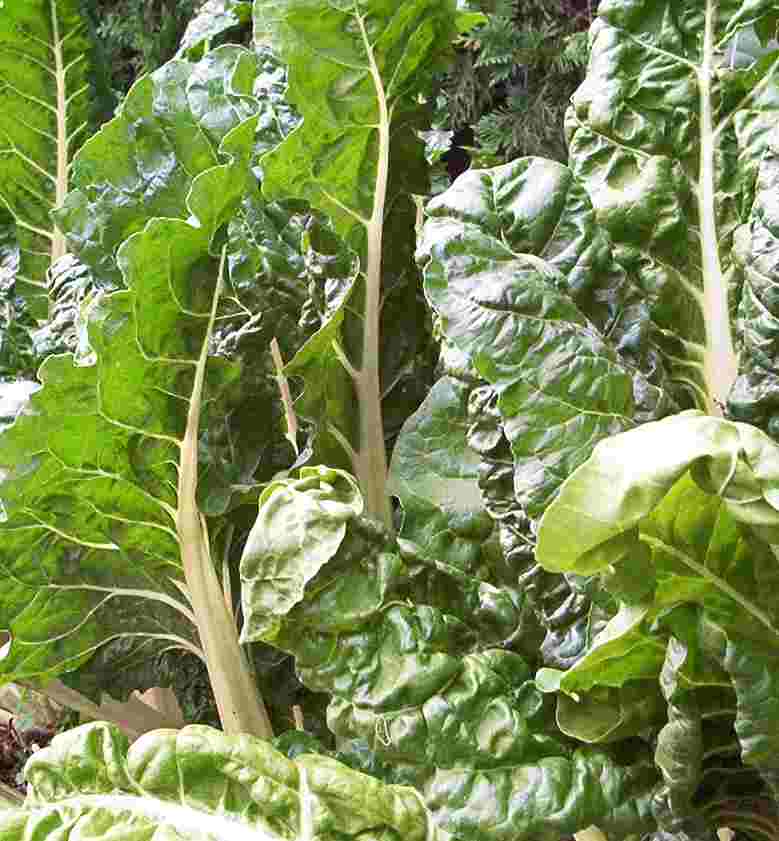
Swiss chard. Photo: Spalding, Wikimedia Commons; public domain.
Swiss Chard
Swiss chard is a productive leafy vegetable grown for its broad leaves and substantial midribs. It is related to beets, but it is selected for foliage rather than a storage root. Chard is adaptable, harvests over a long period, and generally tolerates heat better than spinach, although leaf quality and growth slow during prolonged hot weather.
Crop identity
Scientific name:Beta vulgaris Cicla Group (often listed as B. vulgaris subsp. cicla)
Family: Amaranthaceae
Crop type: Leafy vegetable.
Life cycle: Biennial, commonly grown as an annual or short-lived perennial crop.
Edible portions: Leaves and fleshy leaf stalks.
Propagation: Seed clusters sown directly or started in modules for transplanting.
Types and variety selection
Chard cultivars include green- and white-stemmed forms, brightly colored red, pink, orange, or yellow stems, and mixed-color selections often sold as rainbow chard. Differences include leaf texture, stem width, color stability, maturity, and tolerance of heat or bolting. Select varieties for culinary use and local disease pressure rather than color alone. Each chard seedball may contain more than one seed, so seedlings often emerge in clusters.
Climate, light, and soil
Chard grows in full sun and tolerates partial shade, especially where summers are hot. It performs best in cool to mild weather but is more heat tolerant than spinach. High temperatures slow leaf production and can make leaves tougher or stronger flavored. Chard tolerates light frost, although hard freezes can damage foliage. Use fertile, well-drained soil with good organic matter and a soil pH suitable for beets and other garden vegetables. Maintain even moisture to support tender leaf growth.
Sowing and planting
Direct sow when soil is workable and not waterlogged; chard can be planted in succession for a steady supply. Sow seed clusters about ½–1 inch (1–2.5 cm) deep, following the cultivar packet, and thin seedlings to roughly 6–12 inches (15–30 cm) apart depending on desired plant size. Rows 12–18 inches (30–45 cm) apart are common in garden beds. Transplants are useful for an earlier start or a more orderly stand. Handle seedlings gently because several sprouts may share one seed cluster.
Care and maintenance
Keep the root zone evenly moist and mulch to reduce evaporation and weeds. Chard is a moderate feeder; incorporate mature compost and use soil-test results to guide additional fertilizer. Avoid excessive nitrogen, which can produce lush growth without improving eating quality. Remove damaged outer leaves and keep the bed weeded while plants establish. A succession sowing can replace older plants as leaf quality declines.
Pests, diseases, and common problems
Leafminers can tunnel through leaves; remove and dispose of badly affected leaves rather than composting heavily infested material. Aphids, flea beetles, slugs, and leaf spots may also occur. Floating row cover can exclude some early-season insect pests, but remove it when plants need access for maintenance or if heat builds underneath. Rotate away from beets and chard where soilborne problems recur. Bolting is uncommon in ordinary summer conditions but can follow prolonged cold exposure or plant stress in susceptible cultivars.
Harvesting
Begin harvesting outer leaves when they are large enough to use, leaving the central growing point intact. Cut stalks cleanly near the base rather than tearing them. Repeated outer-leaf harvest encourages continued production; avoid removing so much foliage that the plant cannot replenish itself. For a one-time harvest, cut the whole plant above the crown if the cultivar and growing conditions allow regrowth. Leaves are generally more tender when harvested young.
Storage and preservation
Refrigerate leaves promptly in a breathable bag or container and use while crisp. Separate leaves and stalks if they will be cooked differently. Chard can be blanched and frozen for later cooked dishes; follow a reliable blanching and freezing procedure. Do not improvise home-canning methods for leafy greens. Use tested recipes from the National Center for Home Food Preservation or Cooperative Extension.
Growing in different spaces
Chard works well in raised beds, mixed vegetable borders, and large containers. A container should provide enough soil volume for a substantial root system and must be watered consistently. In small gardens, a few plants can provide repeated harvests. Indoors, chard can supply baby leaves under strong grow lights, but mature plants need considerable space and light.
Regional adaptation
Northern and short-season climates: Direct sow as soon as soil can be worked or transplant after hardening off. Light frosts are usually manageable; protect plants from severe freezes.
Temperate climates: Sow in spring and again for autumn harvest. Succession planting helps bridge seasonal gaps.
Hot and humid climates: Use morning sun and afternoon shade during peak heat, maintain airflow, and avoid keeping foliage wet overnight.
Hot and dry climates: Mulch and consistent irrigation are critical; partial shade can reduce heat stress and leaf toughness.
Mediterranean climates: Grow through the cooler, wetter season and use shade or careful irrigation during dry summer conditions.
High-elevation sites: Cool nights may extend the useful season, but frost can arrive early. Use local frost timing and consider row cover for shoulder-season harvests.
Subtropical and tropical climates: Grow during the coolest part of the year; heat and humidity can reduce quality and increase leaf disease pressure.
Planting windows depend on local soil temperature, day length, heat patterns, and the desired harvest period—not a single national date.
Editorial status: Foundational crop profile. Growing performance, cultivar maturity, and planting windows vary by region and site. Confirm timing and pest management with local Cooperative Extension guidance.