
THE FOUNDRY CROP ENCYCLOPEDIA · ROOT AND TUBER CROPS · WARM-SEASON CROP
Sweet Potatoes
Sweet potatoes are heat-loving vines grown for their nutritious underground storage roots. They are productive in warm climates and can succeed in cooler regions when gardeners choose early cultivars, warm the soil, and give the crop a long enough frost-free window.
Crop identity
- Scientific name: Ipomoea batatas
- Family: Convolvulaceae (morning-glory family)
- Crop type: Warm-season root crop; the harvested portion is a storage root, not a true tuber.
- Life cycle: Tender perennial in frost-free climates; usually grown as an annual for roots.
- Edible portions: Storage roots; young leaves and shoots are eaten in some cuisines.
- Propagation: Vegetative slips or vine cuttings, not ordinary seed for routine home production.
Types and variety selection
Sweet potatoes vary in skin and flesh color, texture, sweetness, storage behavior, vine length, and maturity time. Orange-fleshed types are common, but white-, cream-, yellow-, and purple-fleshed cultivars are also available. Texture may be moist and soft or drier and firmer after cooking. Choose a cultivar with a maturity period that fits your actual growing season, not simply the number of warm days listed for a different region.
- Long-vine types: Spread widely and can cover substantial bed space; useful where ground area is available.
- Bush or compact types: More manageable in small gardens and large containers, though they still need warm soil and adequate root volume.
- Short-season cultivars: Particularly important in northern and high-elevation gardens; compare local trial results and days-to-maturity information.
Climate, light, and soil
- Light: Full sun, ideally at least 8 hours of direct light for strong root production.
- Temperature: A very tender, heat-loving crop. Plant slips only after frost danger has passed and the soil is warm—around 65°F (18°C) is a commonly used minimum. Growth slows in cool conditions; chilling injury can occur when roots are exposed to soil temperatures below about 50°F (10°C).
- Soil: Loose, well-drained sandy loam or loam favors smooth, well-shaped roots. Heavy, compacted, rocky, or waterlogged soil can produce misshapen roots or rot. Raised beds or broad ridges can improve drainage and soil warming.
- Soil reaction: A mildly acidic soil is generally suitable; use a soil test before adjusting pH.
- Water: Keep plants evenly supplied during establishment and root development. Avoid waterlogging, especially as harvest approaches.
- Fertility: Avoid excessive nitrogen, which can produce vigorous vines at the expense of storage-root development. Base amendments on a soil test.
Starting slips and planting
Sweet potatoes are planted from slips: shoots grown from a healthy storage root or purchased from a reputable supplier. Certified, disease-free slips are the simplest option. Home slip production takes several weeks and requires warmth; grocery-store roots may be treated to inhibit sprouting and may not be true to a named cultivar.
- Prepare loose, well-drained soil and form ridges or raised beds where drainage or early warming is needed.
- Wait until frost danger has passed and the soil has warmed to at least about 65°F (18°C); warmer soil supports faster establishment.
- Plant healthy slips deeply enough to cover the lower stem nodes while leaving the leaves exposed. Follow supplier guidance for the cultivar and planting method.
- Space plants according to vine habit and available room. Long-vine cultivars need more area; compact types can be planted more closely.
- Water thoroughly after planting and maintain moisture while roots establish.
Care through the season
Once established, vines spread and shade the soil, helping suppress weeds. Weed carefully while plants are small; deep cultivation later can damage developing storage roots. Keep irrigation consistent during active growth, then avoid excessive late-season watering if soil is already moist. Do not routinely prune healthy vines: heavy cutting removes productive foliage and can reduce root growth.
Pests, diseases, and common problems
Potential problems include wireworms, white grubs, sweet potato weevils in affected regions, flea beetles, root-knot nematodes, and fungal or bacterial storage-root rots. Rotate crops, use healthy slips, remove volunteer plants and crop residues, maintain drainage, and inspect roots during harvest. Avoid planting sweet potatoes repeatedly in the same ground. Diagnose pest or disease problems locally before applying a treatment; the important pests vary considerably by region.
Harvesting
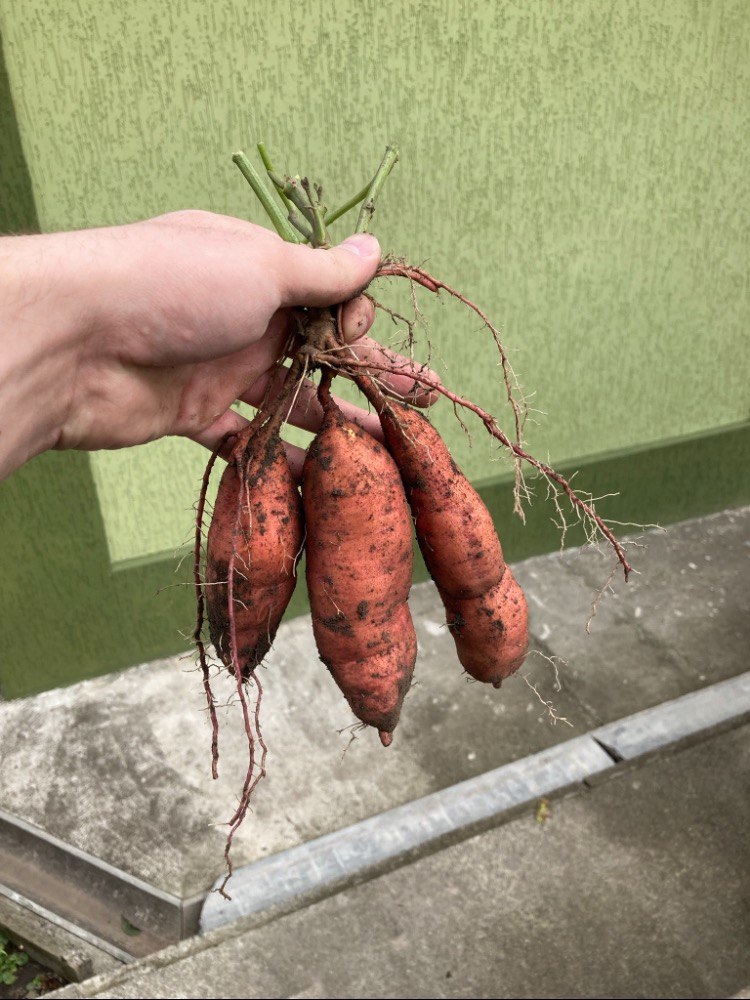
Storage roots begin forming early and continue enlarging; they do not reach a single botanical ripeness stage. Harvest timing balances root size, cultivar maturity, market or kitchen preference, and the risk of cold soil. Many cultivars are harvested roughly 90–120 days after planting, but local trial data and the actual weather matter more than a generic range. Harvest before frost damages the vines and before soil becomes cold or waterlogged. Loosen soil well away from the crown and lift roots carefully to avoid cuts and bruises.
Curing, storage, and preservation
Curing helps heal minor skin injuries and improves eating quality by allowing starches to convert to sugars. Commercial curing commonly uses warm temperatures and high humidity for several days; home gardeners can use a warm, humid, well-ventilated space while avoiding condensation and rot. Follow a reputable extension method for the temperature, humidity, and duration achievable in your setting. After curing, store roots in a dark, ventilated location around 55–60°F (13–16°C). Do not refrigerate raw sweet potatoes: cold storage can cause chilling injury. For freezing, canning, or other preservation, use current tested instructions from the National Center for Home Food Preservation or a Cooperative Extension service; sweet potatoes are a low-acid food and must not be canned by improvised methods.
Growing in different spaces
On acreage, give long-vine cultivars room to run and use broad ridges that make harvest easier. In a suburban bed, choose compact varieties or dedicate an edge where vines can spread without smothering other crops. Containers need substantial volume, warm placement, drainage, and a compact cultivar; small pots restrict root development. Indoor production for mature roots is difficult because the crop needs intense light, warmth, and considerable space, although slips can be started indoors before outdoor planting.
Regional adaptation: heat, season length, and elevation matter
- Northern and short-season climates: Choose early-maturing cultivars, use warm raised beds or suitable mulch, plant into genuinely warm soil, and harvest before cold nights and soil temperatures threaten roots. Some locations may find the crop challenging even with season extension.
- Temperate climates: Plant after frost danger and soil warming, then use cultivar maturity and local frost timing to set the harvest window.
- Hot and humid climates: Heat supports growth, but saturated soils and high disease or insect pressure can be limiting. Prioritize drainage, rotation, healthy slips, and locally recommended pest management.
- Hot and dry climates: Reliable irrigation is essential during establishment and root bulking. Mulch and water management help reduce stress, but avoid waterlogging.
- Mediterranean climates: The warm season can be favorable, but cool coastal nights or early autumn rains may shorten the practical window. Time harvest before soil turns cold or persistently wet.
- High-elevation sites: Elevation is not interchangeable with latitude. Cold nights, slow soil warming, wind, and a short frost-free period can make sweet potatoes marginal; warm microclimates, early cultivars, black containers or mulch, and season extension may help, but results are site-specific.
- Subtropical and tropical climates: Long warm seasons can support production, but planting and harvest should account for local wet/dry cycles, extreme heat, and regional pest pressure.
Do not use a state-wide calendar as a substitute for local conditions. Check soil temperature, the cultivar’s maturity information, frost forecasts, and local Cooperative Extension recommendations before planting.
Crop record at a glance
| Scientific name | Ipomoea batatas |
|---|---|
| Family | Convolvulaceae |
| Crop group | Warm-season storage-root crop |
| Propagation | Slips or vine cuttings |
| Planting trigger | After frost danger; soil around 65°F (18°C) or warmer |
| Typical maturity range | Often about 90–120 days, cultivar and climate dependent |
| Sun | Full sun |
| Storage | Cure, then store near 55–60°F (13–16°C); do not refrigerate raw roots |
Sources and further reading
- University of Maryland Extension: Growing Sweet Potatoes in a Home Garden — planting, harvest, curing, and storage.
- Utah State University Extension: How to Grow Sweet Potatoes in Your Garden — cultivar maturity, slips, soil, and storage.
- Oregon State University Extension: How to Grow Sweet Potatoes Successfully in Oregon’s Climate — cool-climate techniques and high-elevation limitations.
- University of Illinois Extension: Sweet Potato — slip production and planting.
- National Center for Home Food Preservation — tested preservation procedures.
Editorial status: Foundational crop profile. Cultivar performance, maturity, planting windows, pest pressure, and storage results vary by region and handling. Use local Cooperative Extension guidance and tested preservation instructions for final decisions.